Monday, December 12, 2011

Color & Value Research

Paintings:
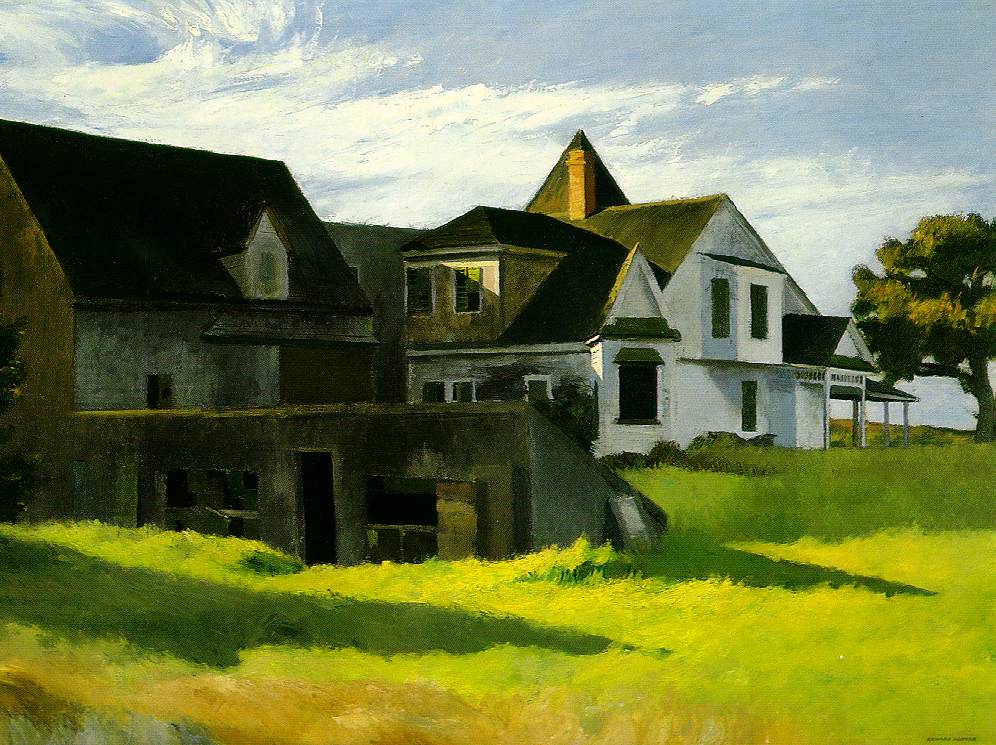
Edward Hopper, “Cape Cod Afternoon,” 1978


Edward Hopper, “Cape Cod Morning” 1978
http://www.americansuburbx.com/wp-content/gallery/edward-hopper/cape-cod-morning.jpg


Philip Guston, “Painting on Floor,” 1978


The first and second picture seems to have an emphasis on green and landscape and has an almost older feel to them (time period). The last picture seems almost creepy with the red and the crooked flore boards.

Drawings:

Georges Seurat, “Puffers Pond”


Vincent Van Gogh, “Wheat Field with Cypresses at the Haude Galline near Eygalieres”
The first picture looks more gloomy because overall it's darker. The second picture looks more positive because there are more ligher colors than darker ones.


Saturday, December 3, 2011

Essential Questions

We can access images of anything via the internet and snap photos with our phones, so why are drawing and painting still viable methods for making images? What can drawing and painting do that digital and photographic media can’t?
Drawing and painting are viable methods for making images because people use it to express themselves and show the world how they see and view a particular thing. Whereas photography is a snapshot of a particular thing through a lens. 
Though photography is open to different interpretations, this is the case for any type of art, literature, and even everyday situations. Drawing is more open to creative decisions and thoughts though because the artist can put in or take out whatever they want. Drawing and painting is open to interpretation just as photography but some may argue that it can convey deeper meanings by the things that are added or taken away from a photograph.

How can we use the methods, materials, and techniques used by two-dimensional artists today to tell the story of our lives and to address contemporary issues?
Two-dimensional artists today can tell stories about their lives and try to address current issues within society and the world by using different methods, materials, and techniques. One could simply try and draw out their lives but that would be nearly impossible. Instead, if someone is asked to draw out their lives, they would probably try and pick out important things that have effected them. They could then transfer their thoughts onto paper figurally or symbolically. This would be the same case for issues; one could use dark colors or people showing distress on their faces and maybe provide hope or a solution somewhere within the drawing or painting

Wednesday, November 30, 2011

Found Marks

1.  Dew on the cars from the rain. 11/29/11 at 5:15 a.m.

2. Steam from my shower at school after hockey. 11/29/11 at 7:25

3. Sunset on my way home with lots of pinks and reds, it was really incredible. 11/29/11 4:15

4. Reflection of colorful trees on the Charles River. It was like a colorful picture but not made by humans and it was really beautiful. 11/29/11 at 4:15 p.m.

5. Leaf print in cement outside of my house made by a leaf when they re-paved during the fall a few years ago. 11/29/11 at 4:30 p.m.

6. Trail of pumpkin seeds made from squirrels. 11/30/11 at 7:00 a.m.

7. Toady in art when I looked outside at the roof and there were puddles of water that looked like little ponds made from the rain. 11/30/11 at 8:50 a.m.

8. Footprints made by my dog when I was walking her on Mystic Valley Parkway. 11/30/11 at 7:00 p.m.

9. Canadian Geese poop when I was on a walk with my dog. 11/30/11 at 7:00

10. Stars and moon in the sky. 11/30/11 at 7:55 p.m.

Tuesday, March 1, 2011

Artist Statement

You know when you're little and nothing phases you at all? For all you know, you could be the next president of the United States and anything before you is yours. Including that blank piece of paper that within seconds turns into a drawing of a girl with a triangle skirt or a boy with one eye bigger then the other (non-intentional of course.) Back then I didn't need to think about what to draw, I just drew like every other kid. However, the difference between then and now is the importance of the drawing. I'm not sure what it is, but I've come to realize I have a slight obsession with trees and drawing them. They don't directly hold a huge amount of importance to me, but yet when I see them, I'm overcome with emotions. My guess is that trees go through transformations every year just as people do but they also grow and depending on their environment grow differently which is also similar to people.

A lot can change in a short amount of time, so why not keep the memories on paper in a single shot? That's why the easiest way for me to create art is though photography. I love feeling the buttons beneath my fingers and capturing a certain second but remembering a thousand memories before and after the caption that elicits strong emotions from that time in my life. Blurred backgrounds, the smell of chemicals, timeless, and black and white are the first things that come to mind when I think of that one word.

A lot of times, people might not fully understand the art that I make. Sometimes I think I make it to please my audience and to look nice, but I've learned that this isn't the type of art that's special to me. The type of art that's special to me holds significance to me and is something that will make me smile when I look at it because I remember a time or a certain event or even person behind it. Yeah, my work might look nice too, but it isn't about that. I want my art to please, but I mostly want it to please myself and I want people to appreciate it for what it is, not for what it isn't. People can interpret what they want from it weather good or bad and they don't need to necessarily understand the piece, that part is for me to know and others to guess upon.
Friday, February 25, 2011

Process Reflection #2

 Though this week was rather short (having a total of three days which can also be translated into roughly four hours of work). Dispite it being short I felt as if I got a lot of work done. I was able to start and finish the actual painting on my first of three paintings. (Purple below)
In addition to, I also was able to almost finish another of the tree paintings. I had to cut out newsprint which took a while and so did pasting 
it onto the board, but I was able to basically finish that part of the process. My biggest problem this week was trying to figure out what to put on the last two paintings.
 

Lastly, for our last week together, I am planning on finishing the last of the paintings.

Art 21 Reflection #3

Vija Celmins: time
'Builds a painting' rather then 'paints a painting.' She makes a structure. Her paints have these allusions as if you're right there. For a while she painted things that could be turned on like hotplates and lights (things that were around her studio.) Always thought that it was impossible to go right from nature. She tests herself and pushes herself to make things. She doesn't only draw, she's used lithographs as well. The images that she picks are already surfaces and later inspire her. I think she said that she tries to neutralize emotion...Celmins work is incredible. She knows what she wants her work to do from the beginning (an image of how she wants it) I relate because what she does is so perfect and seems like a perfectionist just like me. However, I know that I would never be able to have the patience to do what she does.


Elizabeth Murry: humor

Makes something happen with a fluid material (paint). Primary thing that paint is about is harnessing it. Shapes are carton-y, lumpy, rounded, inflated, wacky and connected. It never directly said it, but from what I saw, she didn't paint on canvas, it was on like wood with maybe canvas over it? But it each painting had holes and wasn't just a solid. She said that she lets the cards fall and see what they make in the end. She likes to used intense color and tries to make it work with everything else in her paintings. Conflict and tension, she wants them to 'live together.' Just like us, she has an art book type thing to have a place for her to start from. As much as she always wanted to be an artist, she also wanted to be different. I think that that's what makes me relate to her the most. Had trouble finding herself, but this one painting called 'Excavation' really started to make her 'feel her body and her mind.' Once her hand is in control, she lets her feeling come through. She loves quiet, and sometimes, I need to be by myself too. Not because I don't love talking, but because sometimes it's nice to just think. 

Saturday, February 19, 2011

Art 21 Reflection #2

On your blog name the artists you learned about and describe what their work is about. What is the artist trying to do with their work? What do you think of their work? How do you relate to it or not?


Andrea Zittel: Consumption: makes homes and clothes that challenge the viewer.

Zittel created furniture that would function as everything that she needed because she didn't have much room in her first house. Her sink functioned not only as a sink, but also as a bath. She had a revalation that no one really wants perfection but that people really want hope for a 'new or improved better tomorrow.' Her work is influenced by where she's lived. She believes that her main issues of art work are human values and perceptions. A lot of her work is about creating intimate personal controllable situations. She says that a lot of her work is humorous and dark at the same time. Zittel creates clothing as well that she wears. She crochets dresses and wears them for a 'season' of four months. I'm not completely sure if she only wears that garment or if she used to only wear it. That part was a bit tricky to understand. Zittel seems like a very personal yet complicated woman who I feel sort of an emotional connection to in addition to really enjoying her art and creative way of thinking.


Michael Ray Charles: Consumption: paintings with pop culture references.

Likes to question.  


Mel Chin: Consumption:


Loves making things with his hands. Stops and listens to learn. SPAWN=special, projects, agriculture, worms, neighborhoods. Conceptual art. Believes that "making art is not about one track, one method but the reversibility of mediums and techniques is minor, but the versity of ideas and how they survive and the methods they are transmitted is very important."